ALL GAMES
THE SUDOKULOFT COLLECTION / 90 PUZZLES

Sum Square

A handful of numbers. Everything in balance.

How to play
Easy / PUZZLE 01

Finding balance 01

Use 1–9, once each• Printed numbers stay fixed
100 so far
1814 so far
172 so far
72 so far
185 so far
209 so far

Targets appear beside rows and below columns. Any valid arrangement counts.

Opening your notebook…

Your answers save in this browser. Take a break whenever you like.

THE ILLUSTRATED FIELD GUIDE / SUM SQUARE

Make both directions add up.

Use each number exactly once so every row and column equals its printed target. The filled squares with a small dot are fixed clues. Any arrangement satisfying all the totals is a valid solution; you do not have to guess a hidden order.

01

Read the outside targets
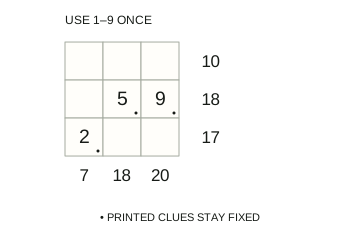
A three-by-three number board with fixed 5, 9 and 2; row targets 10, 18 and 17 on the right and column targets 7, 18 and 20 below.
Rows read across to their targets; columns read down to theirs.

Targets to the right belong to rows; targets below belong to columns. The smaller number shows your running sum. This 3 × 3 example uses every number from 1 to 9 once. Printed 5, 9 and 2 are starting clues and cannot be moved.
02

Find a nearly finished total

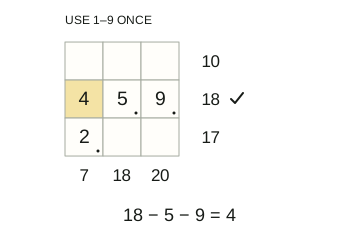
The middle row 4, 5, 9 adds to its target 18; the newly placed 4 is highlighted.
18 − 5 − 9 = 4. One missing square, one useful deduction.

The middle row already contains 5 and 9, which total 14. Its target is 18, so the missing number is 4. Select the empty square and choose 4 from the tray. That number is now used and cannot go in another square.

03

Check the other direction too

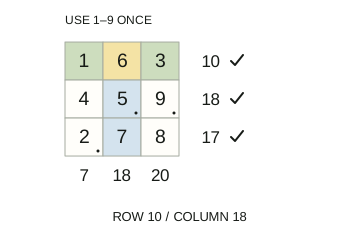
A completed number grid with the row 1, 6, 3 and column 6, 5, 7 highlighted, meeting targets 10 and 18.
The same 6 helps make a row of 10 and a column of 18.

Each number belongs to both a row and a column. In the solved example, 6 is part of row 1 + 6 + 3 = 10 and column 6 + 5 + 7 = 18. A full group shows a check when correct, or an × when its total needs adjustment.

04

Use the whole tray, once each

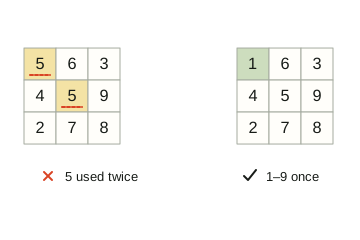
Two example grids: the left repeats 5 and has a wrong row total; the right uses 1 through 9 once and meets every sum.
Repeated numbers cannot be placed. Each tray number has one home.

Fill every editable square and meet all row and column targets. Repeating 5 in the left example breaks the once-only rule. Easy and Medium use 1–9 on 3 × 3, with fewer fixed clues in Medium. Hard uses 1–16 on 4 × 4.

THE FINISH LINE

What counts as complete?

Every square must be filled, every number used once and every row/column target met. A row check alone is not enough: its numbers must also work with the columns.

ONE TO REMEMBER

A common wrong turn

A number that completes one row may make another column impossible. Erase or Undo a recent guess if Hint cannot find a continuation. A fixed clue, marked with a dot, cannot be changed.

AT YOUR FINGERTIPS

Controls & a little help

Select a square and tap a tray number, or type 1–9. Use the tray for 10–16. Arrow keys move between squares. Backspace or Erase clears an editable square; Undo reverses a placement. Hint searches for a valid continuation of your current answers, and places one number when it finds one.

PICK UP WHERE YOU LEFT OFF

Your notebook

Every puzzle is open from the start. Switching puzzles keeps your accepted answers, and Restart clears only the current attempt after confirmation. Your solved record remains. Progress stays in this browser; clearing site data removes it, and another device or browser has its own notebook.