
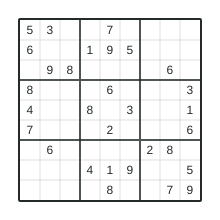
Start with what’s already there.
Every row, column and 3 × 3 box needs the numbers 1–9, once each. The printed numbers are your starting points. You are finding what fits, not adding anything up.
Find a nearly finished group.
A row with eight numbers has only one gap. Work out which number is missing, then check that it also fits its column and box. Rows with two or three gaps are a good next step.
Try a nearly finished row
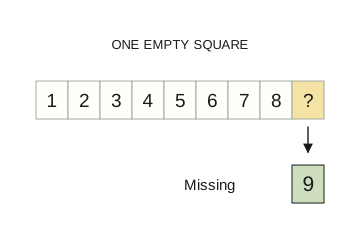
This row already contains 1–8. Its missing number is 9. Before you place it, check the square’s column and 3 × 3 box too. Start with a deduction this small, then look for the next one.
See the full illustrated game guideLook in more than one direction.
A number can look possible in a row but already be present in its column. Before committing, check the row, the column, and the box. Those three views often give you the answer.
Make notes, not guesses.
If a square could hold two numbers, use Notes to record them. Come back when another part of the puzzle narrows the possibilities. There’s no bonus for rushing.